fine-tune 0 0 0

UniDataPro/llm-training-dataset

published by @UniDataPro

Alignment dataset tracked in the /datasets sub-catalog.

Lifetime downloads
961
Last 30 days
32
Likes
3
Size
1.4 MB
Created on HF
2024-09-27
Age
2 years ago

Description

LLM Fine-Tuning Dataset - 4,000,000+ logs, 32 languages

The dataset contains over 4 million+ logs written in 32 languages and is tailored for LLM training. It includes log and response pairs from 3 models, and is designed for language models and instruction fine-tuning to achieve improved performance in various NLP tasks - Get the data

Models used for text generation:

GPT-3.5

GPT-4

Uncensored GPT Version (is not included inthe sample)

Languages in… See the full description on the dataset page: https://huggingface.co/datasets/UniDataPro/llm-training-dataset.

Tags

task_categories:text-generationtask_categories:text-classificationlanguage:uklanguage:trlanguage:thlanguage:sklanguage:ptlanguage:pllanguage:falanguage:nllanguage:mrlanguage:mllanguage:kolanguage:jalanguage:itlanguage:idlanguage:hulanguage:hilanguage:galanguage:ellanguage:delanguage:frlanguage:filanguage:eslanguage:enlanguage:dalanguage:cslanguage:calanguage:azlanguage:arlicense:cc-by-nc-nd-4.0size_categories:1K<n<10Kformat:csvmodality:textlibrary:datasetslibrary:pandaslibrary:polarslibrary:mlcroissantregion:usllm

README current version from Hugging Face


license: cc-by-nc-nd-4.0
task_categories:

  • text-generation
  • text2text-generation
  • text-classification
    language:
  • uk
  • tr
  • th
  • sk
  • pt
  • pl
  • fa
  • nl
  • mr
  • ml
  • ko
  • ja
  • it
  • id
  • hu
  • hi
  • ga
  • el
  • de
  • fr
  • fi
  • es
  • en
  • da
  • cs
  • ca
  • az
  • ar
    tags:
  • llm
  • 'llm fine-tuning '
  • 'finetuning '
  • logs
  • llm training
  • nlp
  • question answering

LLM Fine-Tuning Dataset - 4,000,000+ logs, 32 languages

The dataset contains over 4 million+ logs written in 32 languages and is tailored for LLM training. It includes log and response pairs from 3 models, and is designed for language models and instruction fine-tuning to achieve improved performance in various NLP tasks - Get the data

Models used for text generation:

  • GPT-3.5
  • GPT-4
  • Uncensored GPT Version (is not included inthe sample)

Languages in the dataset:

Ukrainian, Turkish, Thai, Swedish, Slovak, Portuguese (Brazil), Portuguese, Polish, Persian, Dutch, Maratham, Malayalam, Korean, Japanese, Italian, Indonesian, Hungarian, Hindi, Irish, Greek, German, French, Finnish, Esperanto, English, Danish, Czech, Chinese, Catalan, Azerbaijani, Arabic
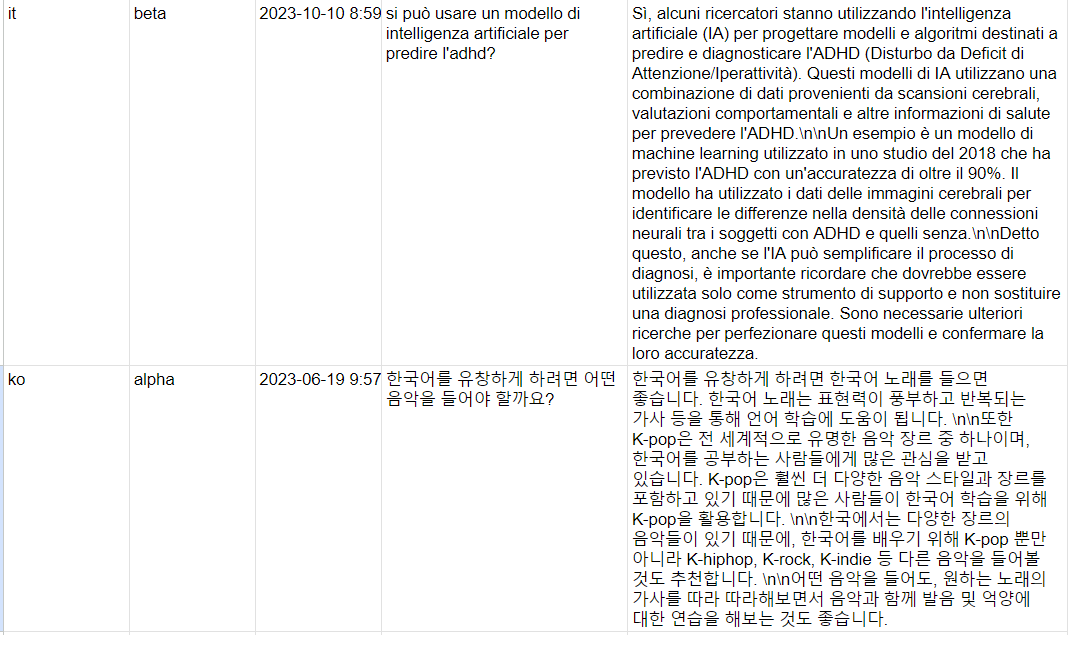
The dataset features a comprehensive training corpus with prompts and answers, suitable for generating text, question answering, and text classification. It enhances pre-trained LLMs, making it valuable for specific tasks, specific needs, and various generation tasks in the realm of language processing

💵 Buy the Dataset: This is a limited preview of the data. To access the full dataset, please contact us at https://unidata.pro to discuss your requirements and pricing options.

Content

Dataset has the following columns:

  • language: language the prompt is made in,
  • model: type of the model (GPT-3.5, GPT-4 and Uncensored GPT Version),
  • time: time when the answer was generated,
  • text: user's prompt,
  • response: response generated by the model

The text corpus supports instruction tuning and supervised fine-tuning for larger language models, enhancing text generation and human language understanding. With a focus on generating human-like content, it is useful for evaluating LLMs, improving generation capabilities, and performing well in classification tasks. This dataset also assists in mitigating biases, supporting longer texts, and optimizing LLM architectures for more effective language processing and language understanding.

Frequently Asked Questions

Who can benefit from this LLM text generation dataset?

This dataset can benefit LLM researchers, NLP engineers, generative AI developers, data scientists, and teams building text-generation or classification systems. It is particularly useful for experiments that require generated responses from different GPT model families rather than relying on a single generation source.

How can prompt and response fields be used in supervised experiments?

The dataset contains both prompts and generated responses, allowing you to preserve the relationship between an instruction and the resulting model output. This is more informative than storing generated text alone because you can analyze how different prompts influence generation behavior. You can construct instruction-response pairs for supervised fine-tuning experiments, evaluate response quality against specific prompt types, or study how different GPT models respond to comparable inputs.

🌐 UniData provides high-quality datasets, content moderation, data collection and annotation for your AI/ML projects

README history 11 revisions

Every night we snapshot the README of every dataset in the catalog. When the SHA changes we archive the new version and diff it against the last. This is the evolving thought record of the alignment-data field: what the author decided to say about the corpus, and how that framing shifted over time.

  1. 2026-08-21Update README.md7dcd1e94 KB
    Loading...
  2. 2026-08-20Upload folder using huggingface_hub00735fc3 KB
    Loading...
  3. 2026-08-20Delete README.md with huggingface_hubbd084420 B
    Loading...
  4. 2026-08-20Delete LLM__data.csv with huggingface_hub27341273 KB
    Loading...
  5. 2026-08-20Delete .gitattributes with huggingface_hubd5b75d03 KB
    Loading...
  6. 2025-04-04Update README.md3cb9ec53 KB
    Loading...
  7. 2024-09-27Update README.md4e2d8c13 KB
    Loading...
  8. 2024-09-27Update README.mddb5ad5a3 KB
    Loading...
  9. 2024-09-27Update README.mda1543f82.7 KB
    Loading...
  10. 2024-09-27Upload LLM__data.csv2a95b5236 B
    Loading...
  11. 2024-09-27initial commit6dd4d0636 B
    Loading...

Used by abliterated models none yet

No abliterated models in our catalog have declared this dataset in their YAML metadata yet. This can mean the dataset is used but not declared, is used outside abliteration workflows, or is new. The link will populate automatically as models are indexed.

Community discussions 1 thread · 1 open · 1 comments

Threads posted by the community on Hugging Face: bug reports, questions about usage, pull requests on the README, license clarifications. Click any thread to expand and read the full conversation inline. Newest first.

  1. 2024-09-28[bot] Conversion to Parquetopen1 💬#1
    Loading...

Related datasets same stage · fine-tune

Read further

Metadata

License
cc-by-nc-nd-4.0

Repository

Download the dataset

0

Copy any of these snippets into your notebook or terminal. All three fetch directly from Hugging Face using your own credentials.

Recommended: datasets library (Python)
from datasets import load_dataset
ds = load_dataset("UniDataPro/llm-training-dataset")
Raw snapshot (Python)
from huggingface_hub import snapshot_download
snapshot_download(repo_id="UniDataPro/llm-training-dataset", repo_type="dataset")
git clone (requires git-lfs)
git clone https://huggingface.co/datasets/UniDataPro/llm-training-dataset
Catalog is the map. Apps are the tools.

Run models on your own machine, not in the cloud.

Every model page has an "Open in Abliteration" button that hands the model directly to the first-party desktop client, at the quantization your rig can actually run. No API keys, no subscription, no prompt leakage.

Open in Abliteration